How to put a shoulder rest on a violin
A shoulder rest is the small clip-on bridge that spans the back of the violin and fills the space between the instrument and your collarbone. Fitted well, it lets your left hand move freely instead of clamping the violin up. Fitted badly, it slides, tilts or drops off mid-practice. This guide walks through the exact motion using the adjustable Cadenza violin shoulder rest, and then deals with the one thing budget rests are famous for: staying on.
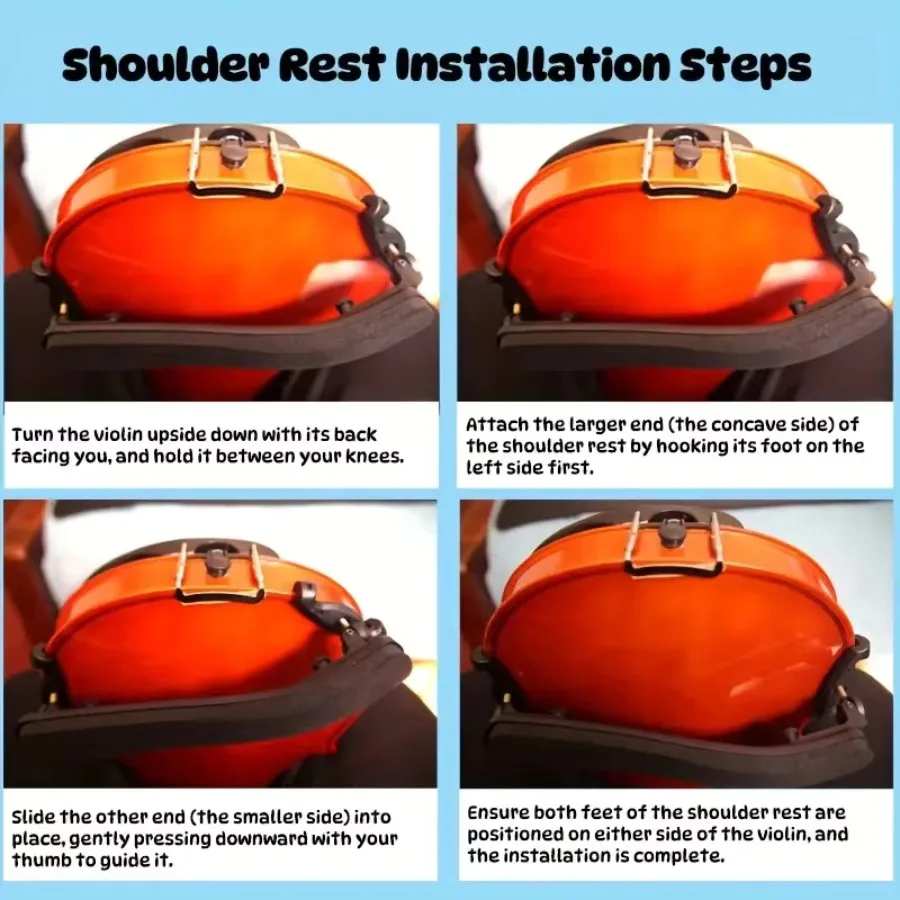
The four steps
- Turn the violin upside down and hold it between your knees. Rest the violin with its back facing you and hold it gently between your knees. This frees both hands and keeps the instrument steady while you attach the shoulder rest, so you never grip the delicate top plate.
- Hook the larger end onto the left side first. The Cadenza rest has one long concave end and one shorter end. Take the larger, concave end and hook its foot onto the left edge of the violin (the lower bout), letting the clip grip the rib. Start on this side because it carries most of the tension.
- Slide the smaller end into place with your thumb. Bring the shorter end across to the opposite edge. Press down gently with your thumb so the foot slides over the rib and clips on. A small, controlled push is all it needs; forcing it can pop the first foot off.
- Check both feet sit on either side, then test the grip. Confirm both feet straddle the violin evenly, one on each side of the lower bout. Give the rest a light wiggle: it should stay put. If it shifts, reposition the feet a few millimeters deeper onto the ribs so the grooves fit snugly and it does not slip.
Get it snug so it does not slip
We will be straight with you, because a couple of our own reviewers raised it: the feet grooves on this model are not deep, and if you only perch the rest on the edges it can work loose. That is a fitting problem far more than a product defect, and it is easy to solve. When you reach step four, do not just confirm the feet are on the ribs; push them home. You are aiming for the moment the groove clicks over the edge and the rest resists a gentle sideways nudge. If you play standing or move around a lot, check the feet again after your first tuning, since that is when a loose rest usually shifts.
Two other habits help. First, keep the feet clean; dust and rosin on the rubber tips reduce grip. Second, if your rest still creeps after seating it firmly, you almost certainly have a size mismatch, which we cover below. A rest that is a touch too wide for the body simply cannot close its grooves, no matter how hard you push.
Match the rest to your violin size
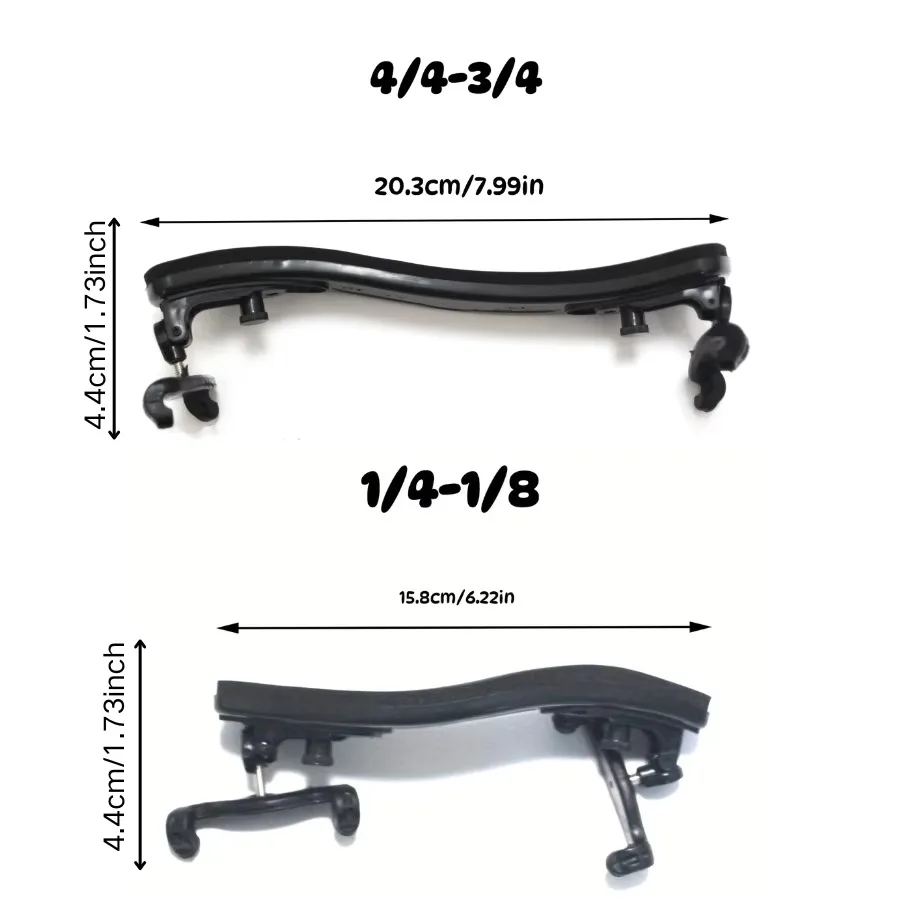
| Violin size | Cadenza model | Rest length | Fit notes |
|---|---|---|---|
| 4/4 (full) | Big | 20.3 cm | Ideal fit |
| 3/4 | Big | 20.3 cm | Fits, at the small end of its range |
| 1/2 | Not covered | - | Neither model fits well; see our sizes guide |
| 1/4 | Small | 15.8 cm | Ideal fit |
| 1/8 | Small | 15.8 cm | Ideal fit |
Notice the gap: the 1/2 size sits between our two models and is not covered well by either. If you play a half-size violin, our full violin shoulder rest sizes guide explains what to do instead of forcing a poor fit. One of our buyers found the big model's smallest setting was still too large for a 3/4, so if you are near a size boundary, read that page before ordering.
Adjusting height and angle
Once the rest is on, small tweaks make a big difference to comfort. The two feet pivot on their joints, so you can widen or narrow the span and change the tilt a little to match the slope of your shoulder. Set it so the violin sits level and your head rests on the chin rest without you hunching or lifting your shoulder toward your ear. If you find yourself clamping down to hold the violin, the rest is too low or the angle is off. Reset, do not muscle through it. Good posture from a correct setup is not a luxury; it is how string players avoid strain over years of playing.
of string players report pain in the shoulder, hand or fingers at some point
— Fishbein et al., ICSOM survey of 4,025 musicians, 1988
prevalence range of playing-related musculoskeletal disorders in string players across studies
— Systematic review, Journal of Manipulative and Physiological Therapeutics, 2018
daily elevated-arm playing above which neck and shoulder pain rises sharply in orchestra musicians
— Work postures and neck-shoulder pain among orchestra musicians, Am. J. Ind. Med., 2007
Those numbers are why setup matters. A shoulder rest is an ergonomic tool, and a 2019 study in Medical Problems of Performing Artists measured how rest height changes the force needed to hold the violin and the load on the neck muscles. The takeaway for players is simple: a rest that fits and is set at the right height lets you hold the instrument with less effort, which is exactly what you want over a long practice session.
Free shipping · 30-day money-back guarantee
Related reading
Once your rest is on and snug, learn how to use a violin shoulder rest for good posture, decide whether you even need one in our take on needing a shoulder rest for violin, and if you also play viola, read violin versus viola shoulder rests. To choose a model, see our buyer's guide and real buyer reviews.
Reviewed and updated June 2026. See how we test.
Common questions
Which way does a violin shoulder rest go on?
The longer, concave end goes toward the lower left edge of the violin (the chin-rest side of the lower bout), and the shorter end sits on the opposite edge. With the Cadenza rest, hook the long end first, then clip the short end. If it feels lopsided under your chin, you have the ends reversed.
How tight should a violin shoulder rest be?
Tight enough that a light wiggle does not move it, but not so tight that the feet splay or scratch the ribs. Push each foot a few millimeters onto the rib so the grooves grip. Snug feet are what stop the rest from sliding off, which is the single most common complaint about budget rests.
Why does my shoulder rest keep falling off?
Usually the feet are not seated deeply enough on the ribs, or the rest is too big for the violin so the grip grooves cannot close. Reseat both feet firmly, and make sure the size matches your instrument. Our sizes guide shows which model fits a full, three-quarter or quarter violin.
Can you leave a shoulder rest on the violin in the case?
Most shaped cases are not deep enough, and leaving a rest clamped on can stress the ribs over time. The Cadenza feet fold flat in seconds, so the safest habit is to unclip it, fold the feet and lay it beside the violin. It takes about five seconds to refit at your next session.
Do beginners need a shoulder rest?
Most beginners and returning players are more comfortable with one, because it fills the gap between the violin and the collarbone so the left hand does not have to hold the instrument up. Whether you should use one long term is a real debate we cover in our guide on needing a shoulder rest.