Violin shoulder rest sizes: which one fits?
Ordering the wrong size is the number one reason a shoulder rest disappoints, so this page exists to get it right the first time. Below you will find the exact measurements from the product itself, a size table by violin fraction, how to measure your own instrument, and an age chart for parents buying for a child. If you already know your violin size, jump to the table. If you are buying for a growing student, read the measuring section, because the label on the case is not always the best guide.
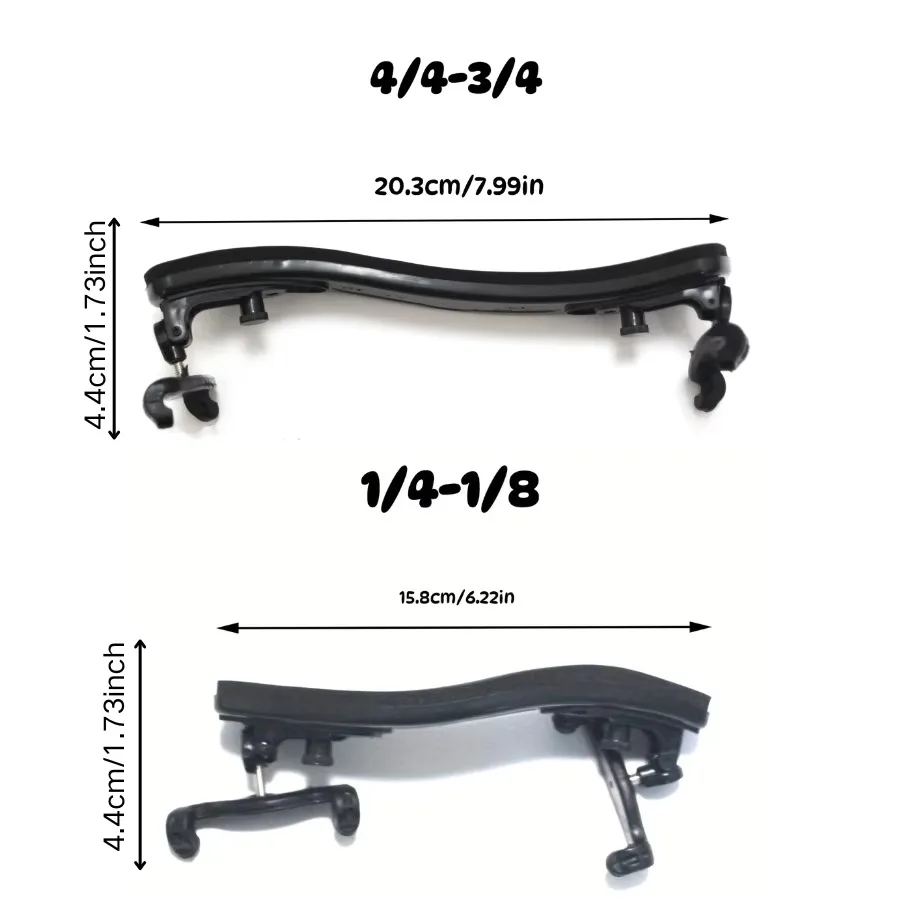
Size table by violin fraction
| Violin size | Typical body length | Cadenza model | Rest length | Fit |
|---|---|---|---|---|
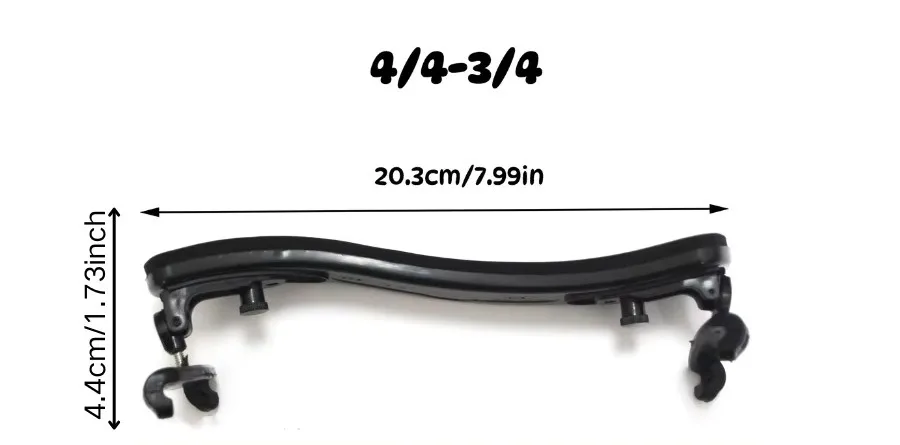
| 4/4 (full) | 14.0 in (356 mm) | Big | 8.0 in (20.3 cm) | Ideal |
| 3/4 | 13.2 in (335 mm) | Big | 8.0 in (20.3 cm) | Good, seat feet firmly |
| 1/2 | 12.2 in (310 mm) | Not covered | - | Neither model fits well |
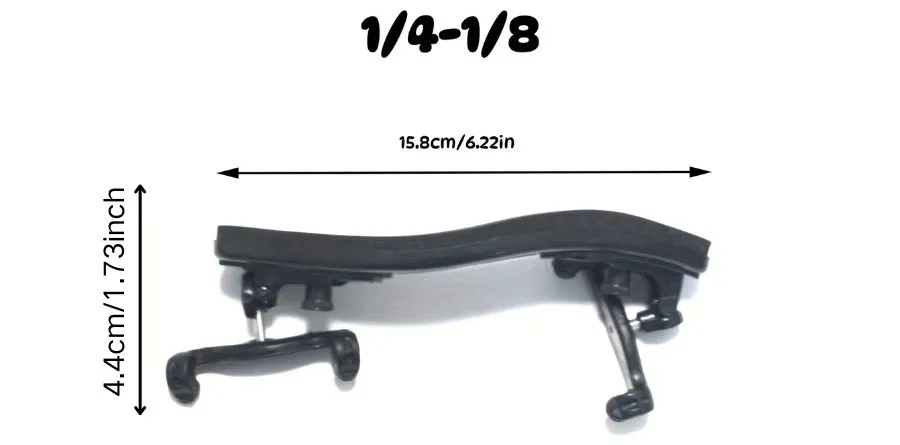
| 1/4 | 11.0 in (280 mm) | Small | 6.2 in (15.8 cm) | Ideal |
| 1/8 | 10.0 in (255 mm) | Small | 6.2 in (15.8 cm) | Ideal |
Body lengths are typical values; individual instruments vary by a few millimeters between makers.
The truth about the 1/2 size
Here is what the numbers say. A 1/2 body measures about 310 mm, which lands between our 15.8 cm small model and our 20.3 cm big model, so neither set of feet closes on it securely. A half size is also a short stop for most children: the next instrument up is a 3/4, and the big Cadenza rest spans 3/4 and 4/4, so fitting it at the size change is the move that lasts, right through to full size. What we would not do is tell you the small will do the job, because on a 1/2 it will not sit securely, and a rest that slides is worse than none.
How to measure your violin
The size printed inside a case or on a rental tag is not always accurate, so it is worth measuring. Use the body length, which is the sounding box only. Place a tape measure at the top edge of the body where the neck joins, and read to the bottom edge. Ignore the neck, the scroll and the strings entirely, because those add length that would throw the number off. Compare your reading to the body-length column in the table above. A 356 mm body is a full-size 4/4, roughly 335 mm is a 3/4, about 310 mm is a 1/2, and around 280 mm is a 1/4.
If you land right on a boundary, size down for comfort rather than up. A rest that is slightly small still grips; a rest that is slightly large cannot close its grooves and will creep, which is the recurring theme in honest reviews of clip-on rests. This is also why our setup guide spends so long on seating the feet: correct size plus firm feet is what keeps the rest where it belongs.
Buying for a child: age to size
| Approx. age | Violin size | Cadenza rest |
|---|---|---|
| 3 to 5 | 1/8 | Small |
| 5 to 7 | 1/4 | Small |
| 6 to 10 | 1/2 | Not covered |
| 9 to 11 | 3/4 | Big |
| 11 and up | 4/4 | Big |
Ranges overlap because children grow at different rates. When in doubt, have a teacher check the fit.
Why the right size protects the player
Sizing is not only about the rest staying on. A violin held at the wrong height or angle makes the player clamp with the neck and lift the shoulder, and that habit is linked to real strain over time. Getting the instrument and rest to match the body lets a student hold the violin with the least effort.
of string players report pain in the shoulder, hand or fingers at some point
— Fishbein et al., ICSOM survey of 4,025 musicians, 1988
prevalence range of playing-related musculoskeletal disorders in string players
— Systematic review, Journal of Manipulative and Physiological Therapeutics, 2018
daily elevated-arm playing above which neck and shoulder pain climbs in orchestra musicians
— Work postures and neck-shoulder pain among orchestra musicians, Am. J. Ind. Med., 2007
None of that means a beginner is in danger, but it does explain why teachers care so much about fit. A correctly sized rest at the right height is the cheapest ergonomic upgrade a young player can have.
Free shipping · 30-day money-back guarantee
Keep reading
Ready to fit it? Follow the step-by-step setup. Deciding between models or wondering about wood versus plastic? See the best violin shoulder rest guide. Playing both instruments? Read violin versus viola shoulder rests. You can also browse buyer reviews or check our 30-day refund policy if the fit is not right.
Reviewed and updated May 2026. See how we test.
Sizing FAQ
What size shoulder rest do I need for a 4/4 violin?
A full-size (4/4) violin takes the big Cadenza rest, which spans 20.3 cm. It is designed around the 356 mm body of a standard adult violin, so it seats cleanly on the lower bout without the feet splaying.
Does the shoulder rest fit a 3/4 violin?
Yes, the big model covers 3/4 as well as 4/4. It sits at the smaller end of its range on a 3/4, so seat the feet firmly. One honest buyer found the big model still a touch large for their particular 3/4, so if your instrument is on the small side, measure the body length first.
Which shoulder rest fits a 1/2 violin?
Neither Cadenza model fits a 1/2 violin well. Its body length falls between our big and small rests, so the big is too wide and the small is too narrow. The big model spans 3/4 and 4/4, so it is the one to fit at the next size change. The section above has the measurements.
What size shoulder rest for a 1/4 or 1/8 violin?
Both 1/4 and 1/8 violins take the small Cadenza rest, which spans 15.8 cm. It is built for the shorter body of a young beginner instrument and folds flat to fit small cases.
How do I measure my violin to find the size?
Measure the body only, from the top edge where the neck joins to the bottom edge, ignoring the neck and scroll. A 356 mm body is a 4/4, around 335 mm is a 3/4, and roughly 280 mm is a 1/4. For a growing child, also measure arm length, since comfort matters more than the label.